
null² -Design Process- null²
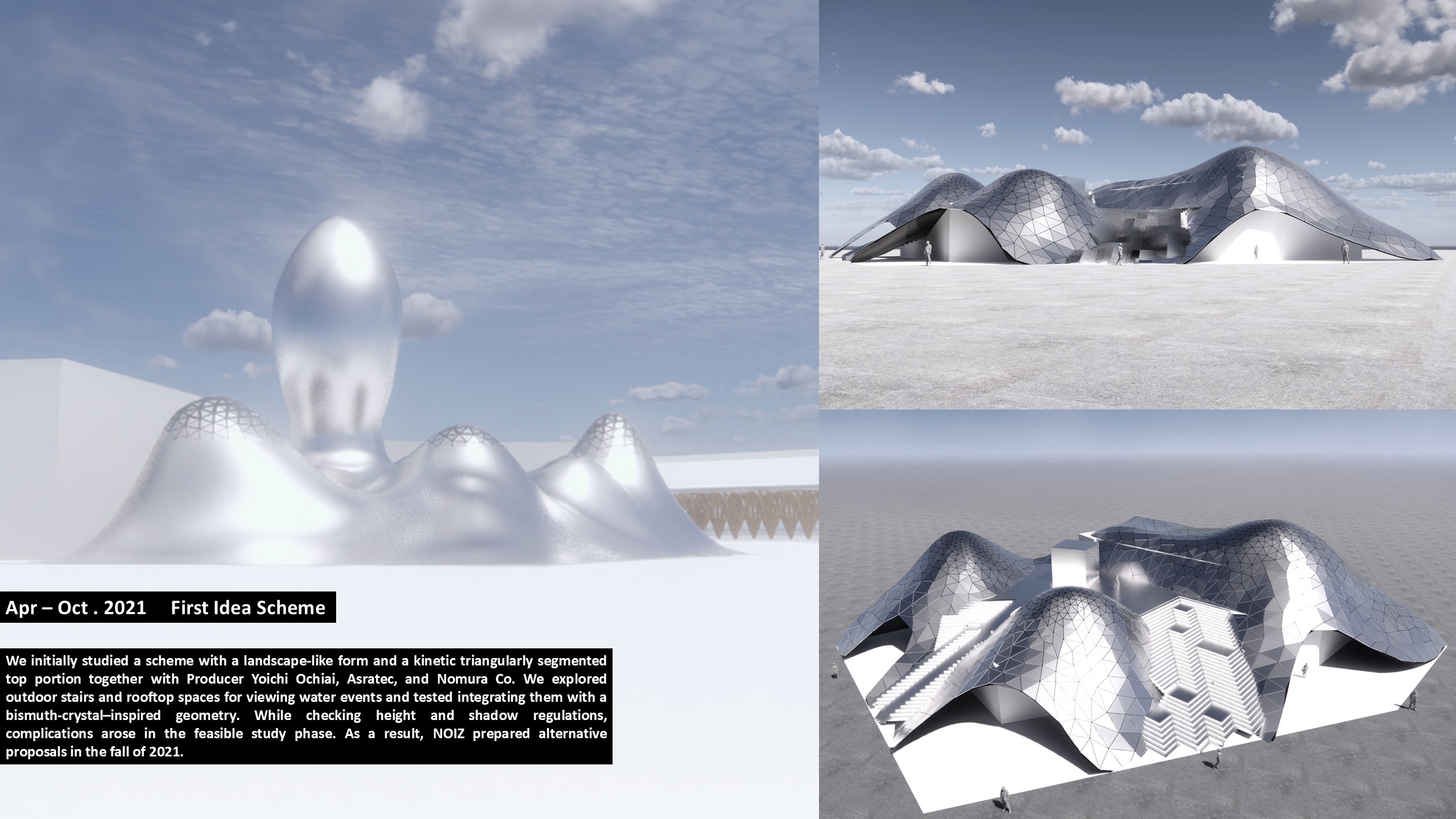
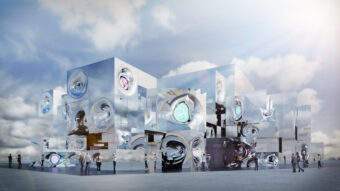
2025年大阪関西万博のシグネチャーパビリオン落合館、通称null²では、落合陽一プロデューサーの全体統括の下、NOIZは博覧会協会の発注による基本設計と、設計施工の元請となるフジタおよび大和リースの下での実施設計および工事監理業務を担当した。落合プロデューサーからの金属質だが液体のような、ヌルヌルと動くパビリオンにしたいという意向の下、NOIZやArupなど協会発注の設計チーム以外にも、動的機構やLEDビジョン、AIなどを扱う専門チームが展示や内外観演出のために結集し、2020年2月から設計を開始した。当初は2階建て回遊展示型の施設で中央にタワーがあり、外装も金属パネルの可動機構として計画が始まったが、さまざまな条件の変化の中で予算規模が大幅に縮小し、2021年夏に外装に鏡面膜を使うことを提案、2022年中ごろまでにほぼ現行の計画規模に縮小する形で計画が進んだ。
金属の硬質感と液体のような流動性、静的な緊張感と動的な変化、複雑な構成とコストなど多くの対立要素を共存させる必要からごく早い段階から新規に鏡面膜の開発検討を始め、2021年8月には太陽工業に新しい鏡面膜の開発とプロジェクトへの参画を依頼した。金属のような光沢と質感を持つ膜材および加工方法の開発には2年以上の時間を要し、多くの試行錯誤や検証を経て98%の反射率を持つ理想的な膜材が完成した。機能的な与件、面積や規模及び屋上利用、内部の回遊性などに関して多くの検討を経ながら、それらの構造およびボリュームに合う外観デザイン案の検討を段階的に進め、2021年11月に落合プロデューサーに4案(1.Bubble、2.Voxel、3.Slime Mold、4.Tube)の提案を行った。この時点ではまだ2階建て、屋上利用も前提とした構成案だった。
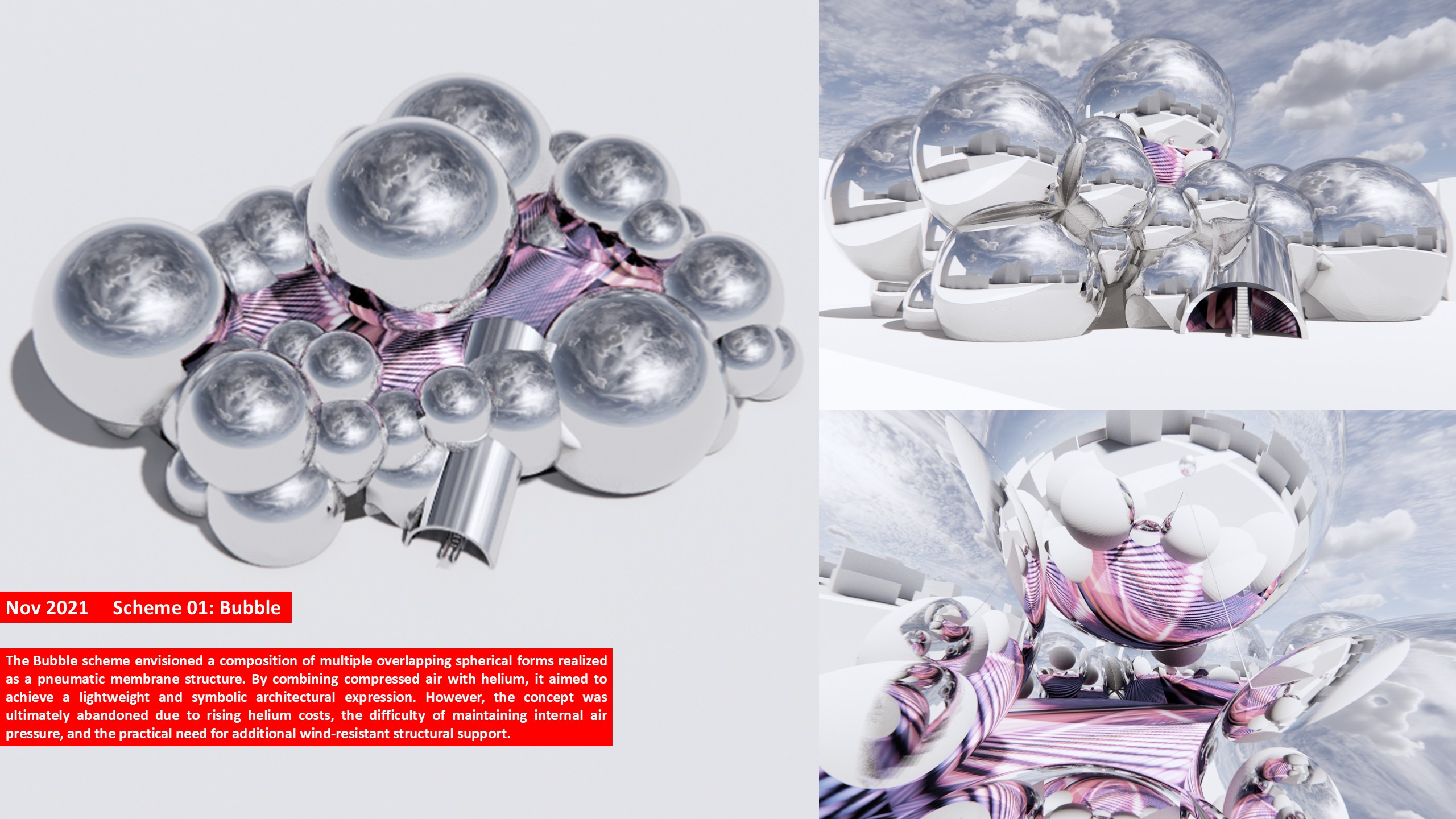
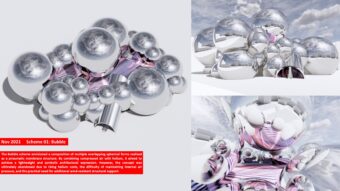
Bubble案は多くの球体が重なり合う形状を空気膜構造として構成した案であり、圧縮空気とヘリウムの併用により軽量でシンボリックな構成を目指したが、ヘリウム価格の高騰や空気圧の維持、現実には耐風構造が別途必要になることなどの理由で見送られた。
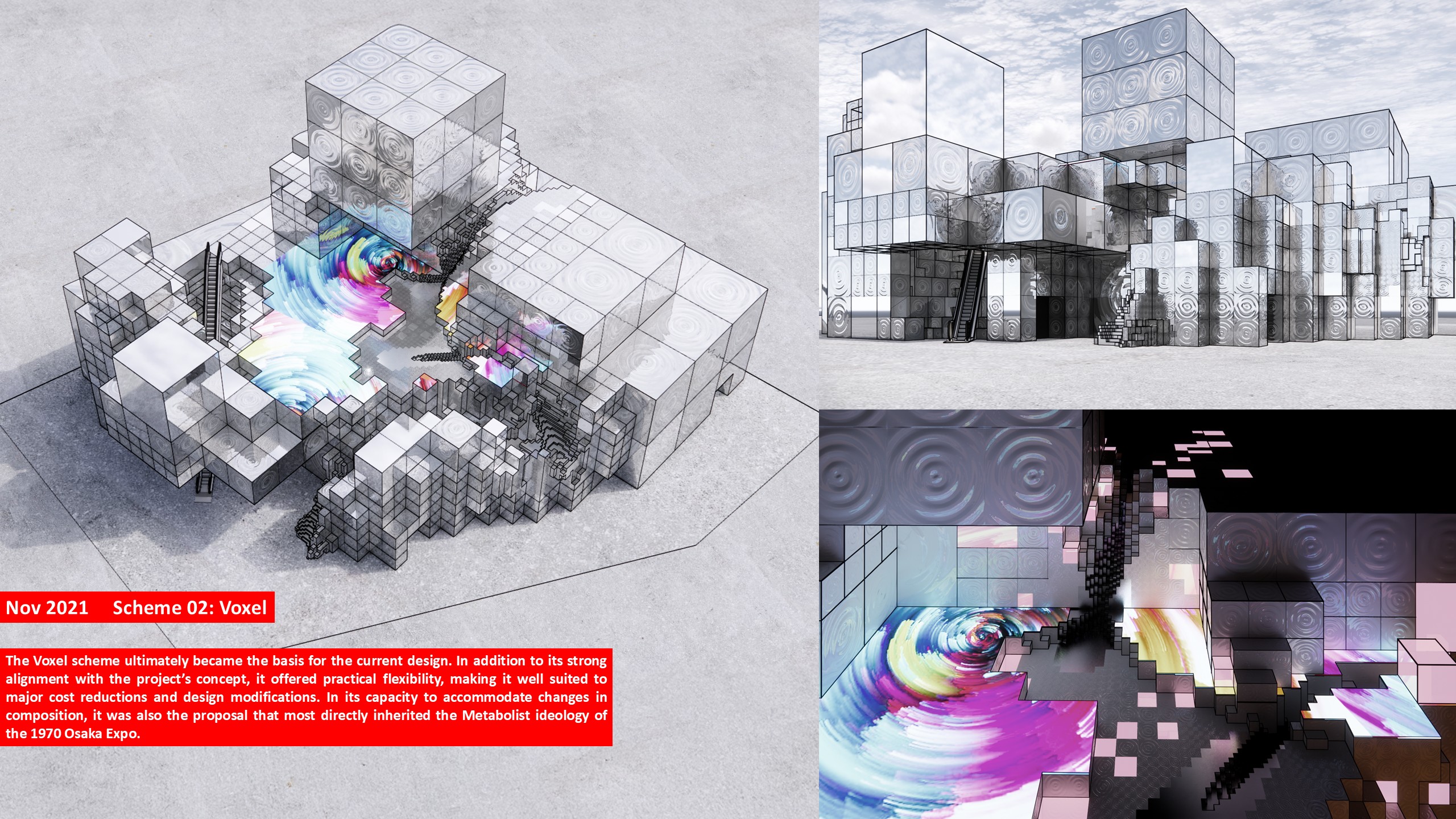
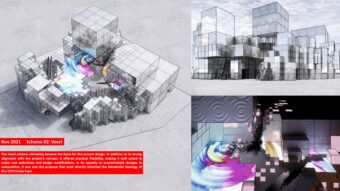
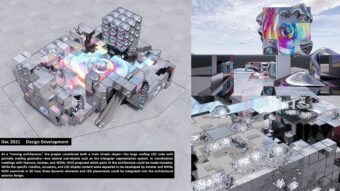
Voxel案は最終的に現行案の元となる案であり、コンセプトとの整合性の他に、大幅な減額や設計変更にも対応しやすい現実性も備えていた。構成の変化を許容するという意味では、最も70年万博のメタボリズム思想を直接的に継承している案でもある。
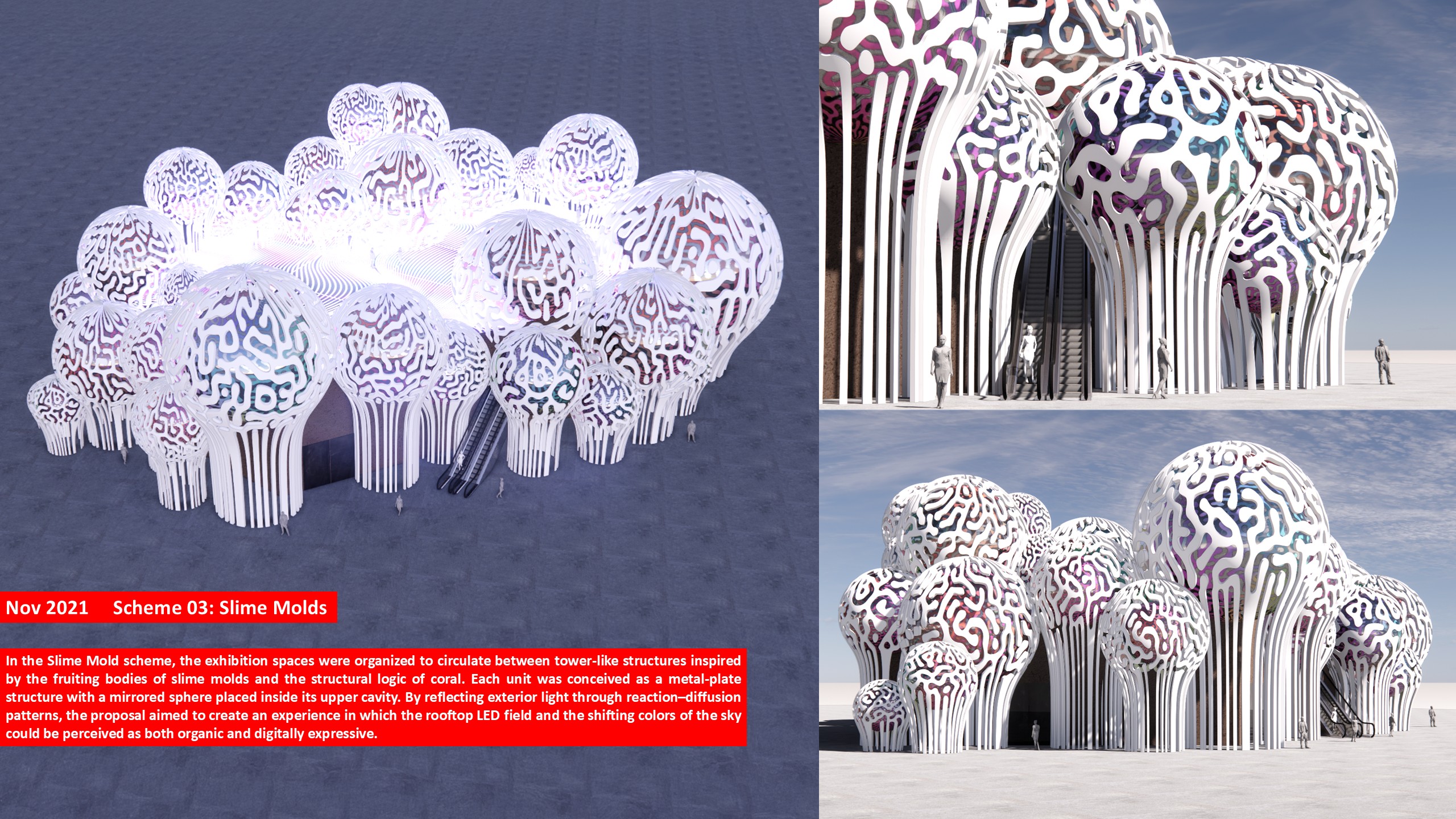
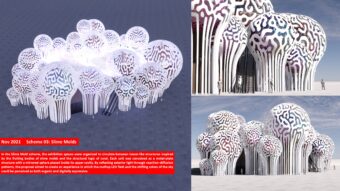
Slime Mold案では、粘菌の子実体やサンゴの構造を参考に、搭状構造の間を巡回するように展示空間を構成する案とした。子実体ユニットは金属板による構造体で、頂部内側には鏡面の球体を配し、反応拡散系パターンを通して外部の光を反射させることで、屋上全面に計画されたLEDや外部の空の色などのうつろいを、有機的であると同時にデジタル表現のように体験できる提案とした。
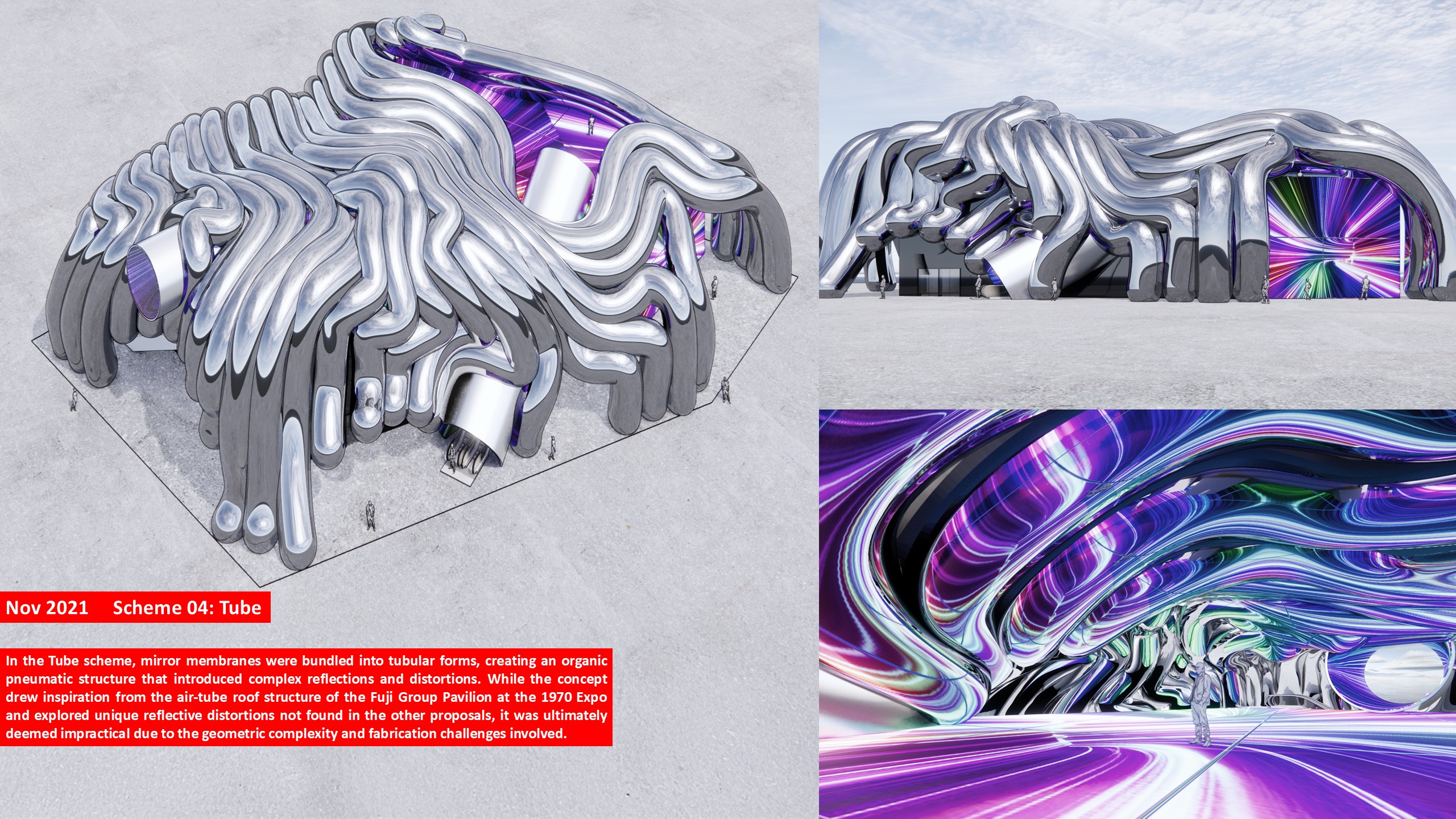
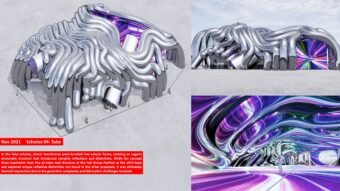
Tube案では鏡面膜をチューブ状に束ね、空気膜構造による有機的な構成で複雑な反射とゆがみを導入する案とした。70年万博の富士グループ館のような空気チューブによる屋根構造を目指しつつ他案にはない独特の反射のゆがみの面白さを検討したが、ジオメトリ展開や加工の複雑さなどにより最終的には実現性が低いと判断された。
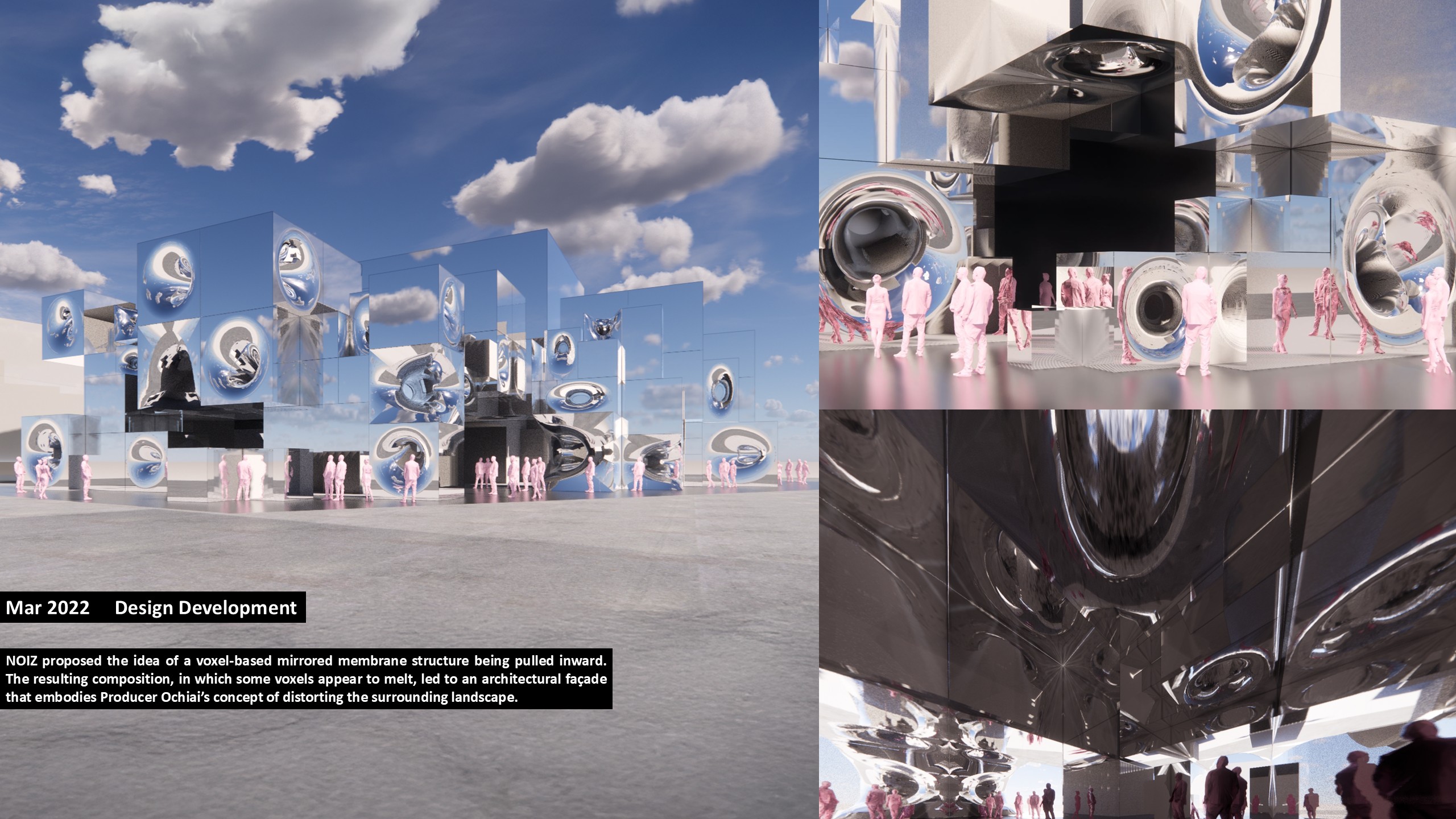
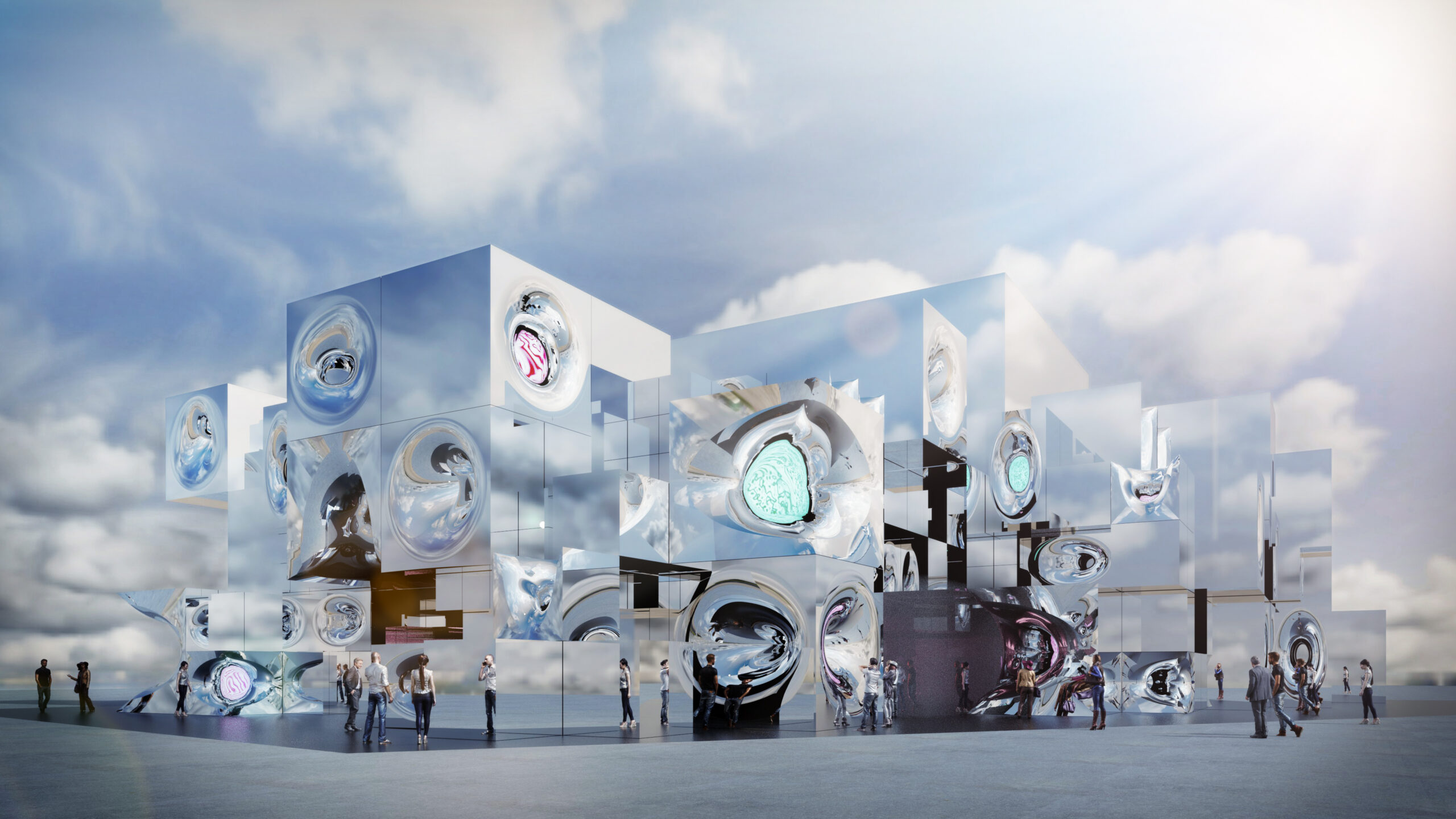
コロナ禍を経てMinecraftのようなデジタル世界でのコミュニケーションが一つの時代の共有体験となった中、バーチャル空間とフィジカル空間の共通要素としてVoxelを構成単位とし、デジタルでかつシャープな幾何学形態である立方体のごく単純な組み合わせを徹底することで、挿入される曲面の時空をゆがめるような効果を最大化するように考えた。Voxel案を考えるにあたり参照したのがChuck Closeの絵画で、グリッドの構成単位に大胆な有機的な形状や配色、効果的に導入されたグリッドの越境など、写実的であるよりも強く光沢や流動性を感じさせる独特の手法を、Voxelを基本とした立体構成へと応用した。1、2、4、8mの単純な倍数系でVoxelを構成することでバイナリー系とのつながりを示しつつ、鏡面が周囲の色や景色、建築のテクスチャを取り込み建築の表層を常に変化させる性質が、純物理的な中にもデジタルな質を体現し、内部展示の純デジタルな世界観との対比と連続性を両立するような構成とした。
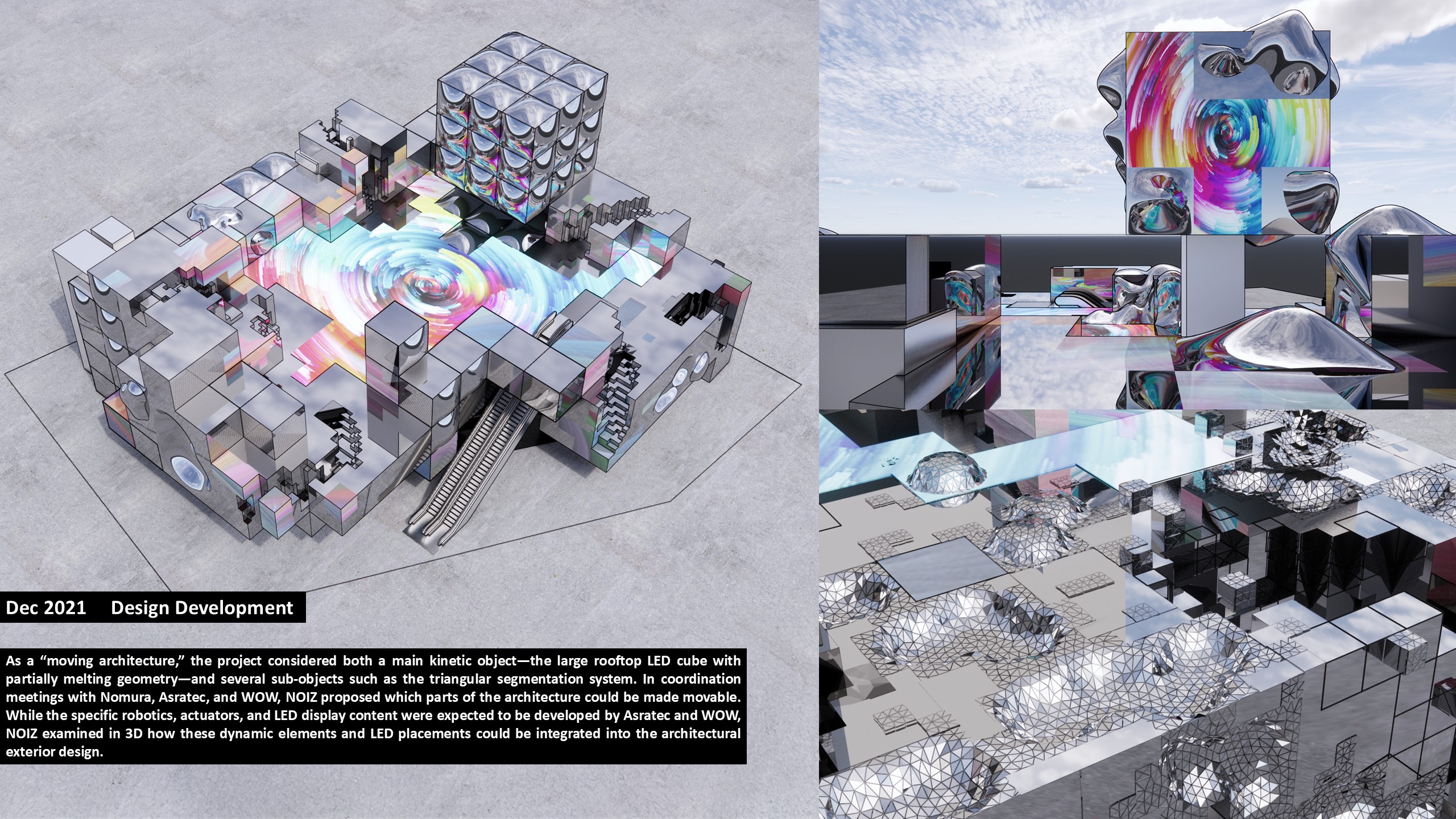
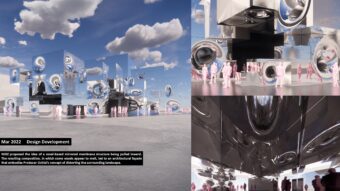
張力構造の安定性と立方体フレームという制約条件から、曲面ユニットはホルン型と鞍型の二種類に限定した。ジオメトリとしての純粋さと実際の膜の挙動や施工性との技術的調整では、Arupおよび太陽工業と詳細な検討を行い曲率の連続性にこだわった。予算の制約上曲面ユニット数は最小限とする必要がある中で、全体としての印象はできるだけ有機的かつ動的になるように、曲面ユニットをパビリオンの正面にあたる西側立面に過剰なまでに集約的に配置し、それ以外はあえて静的な構成とした。動的機構を組み込んだ「動く建築」とすることが前提であり、ロボットアームによる膜の操作や効果の検討も与条件として構造や構成に組み込まれ、設計中にはウーファーによる波面合成も動的機構として追加された。形態要素としてのホルンや鞍型面の配置や、機械要素としてのロボットアームやウーファーの配置に関しては、最終的に動的な建築構成および効果を最大化するように全体会議を重ねて慎重に議論・調整を重ねた。アルミ押出枠の断面形状や目地幅、隠し扉の納まりや膜の蒸着目地の方向・構成など、あえて物質感のない印象を醸造するためにあらゆる詳細にこだわった。
null²は、機械機構やLEDの動画などの能動的要素に加え、反射や曲面によるゆがみ、観察者の視点の移動や天候のうつろいなど、受動的な要素も動的要素として取り込み合成する、リアルとバーチャルを統合する界空間としてのデバイスである。動的な情報を統合する建築は静的な環境であることを超え、自律的なエージェント性を備え始める。null²の場合は機能としてのエージェント性に加え、「目」や「声」を持つことで認知としてのエージェント性も強調している。エージェント的建築は自ら行為と受益の主体となり、積極的に既存のエージェントとしての人の活動や認知に関与する、環境としての建築を拡張する新しい可能性である。
For the Signature Pavilion “null²” at the Expo 2025 Osaka, Kansai, NOIZ was responsible for the schematic design commissioned by the Japan Association for the 2025 World Exposition, as well as the construction documentation and site supervision under the general contractors Fujita Corporation and Daiwa Lease. Under the overarching creative direction of Producer Yoichi Ochiai—who envisioned a pavilion that is metallic yet behaves like a flowing, slippery liquid—NOIZ, Arup, and other association-appointed design teams were joined by additional specialist groups working on kinetic mechanisms, LED vision systems, and AI, forming a multidisciplinary structure to develop the exhibition and interior–exterior environmental effects. Design work began in February 2020.
The initial concept proposed a two-story, circulation-based exhibition facility with a central tower, combined with an operable metal-panel façade. However, amid various evolving conditions, the budget underwent significant reductions. In response, NOIZ proposed in the summer of 2021 to use a mirror membrane for the outer shell, and by mid-2022 the project had been scaled down to nearly its current scope.
Because the pavilion needed to reconcile many conflicting demands—metallic hardness and liquid fluidity, static tension and dynamic transformation, complex composition and cost constraints—NOIZ initiated development of a new mirror membrane material from a very early stage. In August 2021, Taiyo Kogyo was invited to join the project to develop a new type of reflective membrane. Achieving metallic gloss and tactility through membrane fabrication required more than two years of experimentation and testing, ultimately resulting in an ideal material with a reflectivity of 98%. While evaluating functional requirements such as area, scale, roof access, and internal circulation, the team gradually developed exterior design options aligned with feasible structures and volumes. In November 2021, NOIZ presented four proposals to Producer Ochiai:
-
Bubble,
-
Voxel,
-
Slime Mold, and
-
Tube.
At that time, the project still assumed a two-story structure with rooftop access.
The Bubble proposal envisioned a cluster of spherical forms constructed as pneumatic membranes. Combining compressed air with helium would create a lightweight and symbolic structure, but the scheme was abandoned due to rising helium prices, the need to maintain air pressure, and the inevitable requirement for additional wind-resistant structural systems.
The Voxel proposal, which ultimately became the basis for the current scheme, offered strong alignment with the project concept while also providing flexibility to accommodate major budget cuts and design changes. In terms of accepting compositional variability, it was the scheme that most directly inherited the Metabolist ideology of the 1970 Osaka Expo.
The Slime Mold proposal drew inspiration from the fruiting bodies of slime molds and the structural logic of coral. Exhibition spaces circulated between tower-like units, each constructed from metal plates and containing a mirrored sphere within its upper volume. By reflecting outdoor light through reaction–diffusion pattern surfaces, the scheme sought to transform rooftop LED lighting and the shifting colors of the sky into an experience that was both organic and digitally expressive.
The Tube proposal explored bundling mirror membranes into tubular pneumatic structures, introducing complex reflection and distortion effects. While referencing the air-tube roof structure of the 1970 Fuji Group Pavilion, the geometric and fabrication complexity made its feasibility low, and the concept was ultimately set aside.
In the post-pandemic era, when digital environments like Minecraft became a widely shared cultural experience, the pavilion adopted the voxel as its fundamental unit—an element common to both virtual and physical worlds. By rigorously employing simple cubic combinations—1 m, 2 m, 4 m, and 8 m, all binary multiples—the design emphasized the clarity of digital geometry while maximizing the distortion effects of inserted curved surfaces that warp perception and space. The paintings of Chuck Close served as a key reference: their use of grids, organic shapes, bold color variation, and boundary-crossing configurations that express sheen and fluidity were reinterpreted into architectural volumetric compositions.
Due to the constraints of tensegrity behavior and the cubic frame, curved-surface units were limited to two types: horn-shaped and saddle-shaped geometries. Maintaining geometric purity while resolving membrane behavior and construction requirements involved extensive collaboration with Arup and Taiyo Kogyo, with particular attention paid to continuity of curvature. With budget limitations requiring the number of curved units to remain minimal, these units were heavily concentrated on the west elevation—the effective “front” of the pavilion—to create an overall impression of organic dynamism, while other areas were intentionally kept static. From the outset, the pavilion assumed the integration of kinetic mechanisms, including robotic arms manipulating the membrane. During design development, a system to generate wave patterns using woofers was added as another dynamic element. Placement of horn and saddle units, robotic arms, and woofer components was continually refined through full-team discussions in order to maximize the architectural and perceptual dynamism. Every detail—from aluminum extrusion profiles and joint widths to hidden door assemblies and membrane deposition seams—was meticulously designed to intentionally reduce the sense of materiality.
null² ultimately functions as a device that integrates the real and the virtual. In addition to active elements such as kinetic mechanisms and LED imagery, it incorporates passive phenomena—reflection, surface distortion, changes in viewing position, and variations in weather—as dynamic components. Architecture that synthesizes dynamic information ceases to be a static environment and begins to acquire agent-like qualities. In the case of null², these agent qualities are further emphasized by the incorporation of “eyes” and a “voice,” giving the pavilion a perceptual agency as well as functional agency. Such agent-based architecture becomes an actor that both performs and receives, actively engaging human behavior and perception and expanding the possibilities of architecture as an environment.
Project Name
null² -Design Process- null²
Information
-
Year
2025
-
Category
Design Category, Building Type, Design Status, Architecture, Culture, Facade, Realized, Kinetic
-
Status
Built
-
Location
大阪, 日本 Osaka, Japan
-
Collaborator
プロデューサー:落合陽一
構造:Arup
設備:フジタ
施工:フジタ‧⼤和リース特定建設⼯事共同企業体
展示内装設計・施工:乃村工藝社
Producer: Yoichi Ochiai
Structural design: Arup
Equipment design: Fujita
Building Construction: Fujita & Daiwa Lease JV
Exhibition space design / Construction: NOMURA
Related Projects
-
![]()
“L’ouvre 9” Exhibition 2015
2015
Design Category, Design Status
-
![]()
Yashima Observatory
2015
Design Category, Building Type, Design Status
-
![]()
“unnamed ー視点を変えて見るデザインー”
at Tokyo Midtown DESIGN TOUCH 2021 “unnamed -form emerges only sometimes,
so does meaning-” at Tokyo Midtown DESIGN TOUCH 20212021
Design Category, Design Status
-
![]()
House in Herher
2012
Design Category, Building Type, Design Status
-
![]()
Yōga Modern Western Paintings of Japan Exhibition 2017
2017
Design Category, Design Status
-
![]()
ITRI Public Art “Mountain Scape”
2014
Design Category, Design Status
-
![]()
Antiquorum USA Tokyo Showroom
2008
Design Category, Building Type, Design Status
-
![]()
Materializing Exhibition
“Linier Imput 3D-Voronoi Structure”2013
Design Category, Design Status
-
![]()
Exhibition at LIXIL Gallery “CONNECT / DISCONNECT | Asao TOKOLO × noiz”
2020
Design Category, Design Status
-
![]()
Guggenheim Helsinki
2014
Design Category, Building Type, Design Status

View Detail
